
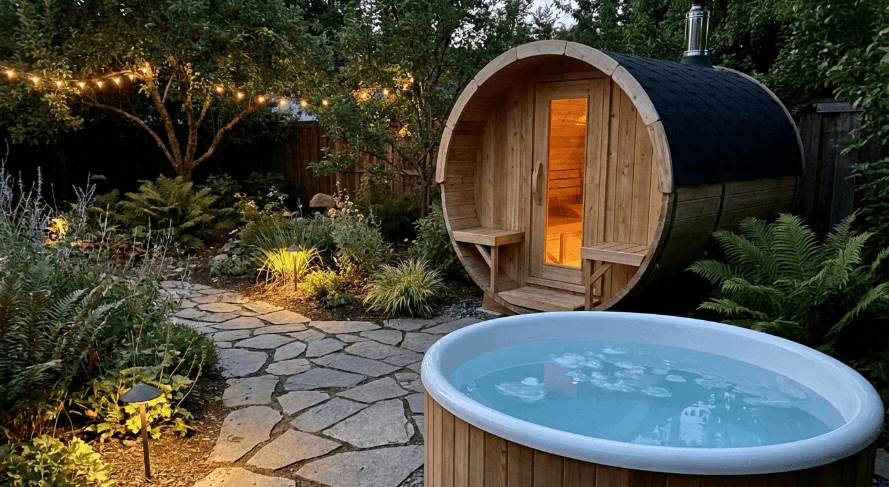
When a room cannot accommodate a full-size traditional sauna, the realistic alternatives are a plug-in infrared panel cabin, a portable infrared dome, or a compact one-person cabinet, all of which fit in 12 to 20 square feet and run on a standard 120V outlet. Carbon and ceramic panels are the two heating technologies behind nearly every compact infrared option, and the choice between them mostly comes down to how evenly the heat spreads rather than one being objectively better. None of these smaller formats fully replicate a traditional Finnish sauna session, but they deliver a similar heat exposure and sweat response in a fraction of the floor space.
What Does the Research Actually Say About Heat Exposure?
Regular sauna bathing has been studied most extensively in traditional, higher-heat Finnish-style use, where large cohort studies have found sauna frequency associated with lower rates of fatal cardiovascular events and all-cause mortality in men followed over years, not proof that sauna use itself prevents these outcomes, but a consistent association across multiple studies. A broader review in Mayo Clinic Proceedings summarized similar patterns across cardiovascular and general health measures tied to regular sauna use. Infrared-specific research is thinner, but the physiological mechanism, raising core and skin temperature to induce sweating and short-term cardiovascular strain similar to mild exercise, is shared across infrared and traditional heat, which is why infrared is generally treated as a reasonable lower-heat substitute rather than something unrelated.
Carbon or Ceramic: Which Panel Type Fits a Small Room?
Ceramic panels concentrate heat into a smaller emitting area and reach their working temperature faster, which suits a buyer who wants quick warm-up in a tight space. Carbon panels spread the same wattage across a larger surface, running cooler at any single point but warming a larger share of the cabin wall, which some users find more comfortable for a longer session. Neither is more or less safe for home use at the power levels found in consumer cabins, and both plug into an existing 120V outlet without any electrical upgrade, which is the main reason compact infrared has become the default recommendation for a room that cannot fit a full sauna.
What Does Low-EMF Actually Mean?
Every electric heating element gives off some electromagnetic field during operation, and infrared panels marketed as low-EMF use shielding or coil arrangement designed to reduce that field further. Typical readings from consumer infrared panels already sit well below the levels produced by common kitchen appliances, so low-EMF is better understood as a design preference some buyers care about rather than a safety threshold that unshielded panels fail to meet. Buyers who specifically want the lower reading should look for a published EMF measurement in the product specifications rather than taking a marketing label at face value.
Where Do Compact Heat Options Actually Fit?
A one-person infrared cabinet or dome can go into a bedroom corner, a home office, or a small bathroom as long as the room has a working 120V outlet, roughly 6.5 feet of ceiling clearance, and a few inches of open air around the unit. Traditional heaters, even small ones, put off more ambient heat and moisture and are a poorer fit for a multi-purpose room, which is part of why infrared has become the go-to substitute when a household wants sauna-style heat but does not have a garage or basement to dedicate to it. For anyone ready to compare specific compact models by wattage and footprint, https://sweatdecks.com lists current infrared cabin sizes side by side.
Is a Compact Alternative Worth It Compared to Waiting for More Space?
For someone who wants a regular heat therapy habit now rather than after a future renovation, a compact infrared option delivers most of the core experience, sweating, elevated heart rate, and a warm-down period, in a fraction of the footprint and without electrical work. It is not a substitute for someone specifically chasing the higher-heat Finnish sauna tradition, where the physiological evidence base is deeper, but for a household weighing a small unit today against no sauna at all, the compact option is a reasonable and well-supported starting point.
How Do Session Length and Frequency Compare?
A traditional Finnish sauna session typically runs 10 to 20 minutes at 150 to 195 degrees Fahrenheit, often repeated in two or three rounds with a cool-down break between them. A compact infrared session usually runs slightly longer, 20 to 30 minutes, at a lower ambient air temperature, since infrared heats the body directly through radiant energy rather than heating the surrounding air to the same degree. This makes infrared more forgiving for someone who finds high-heat traditional sessions uncomfortable or who wants to build up tolerance gradually. Frequency matters more than any single session’s length or heat level. Cohort research on sauna bathing has generally found the strongest associations with cardiovascular outcomes among people who used a sauna several times a week over years, not among occasional users, which suggests that a smaller, more accessible unit someone actually uses three or four times a week may deliver more real benefit over time than a larger, harder-to-access setup used only occasionally. For a small space specifically, that consistency argument is one of the stronger cases for choosing a compact infrared option over waiting indefinitely for room for something larger.
Frequently Asked Questions
What is the smallest heat therapy option for a tiny room? A single-person infrared panel cabin is the smallest practical option, often fitting in a 3 by 4 foot footprint and plugging into a standard 120V outlet. Portable infrared domes take up even less floor space but heat only the body directly.
Is low-EMF infrared actually different from standard infrared? Low-EMF panels are shielded or designed to reduce the electromagnetic field given off during operation, though typical panel EMF levels are already well below common household appliance levels.
Do carbon or ceramic panels heat a small room faster? Ceramic panels tend to reach peak output faster at a slightly higher surface temperature, while carbon panels spread heat more evenly at a gentler temperature. Either heats a small cabin adequately within ten to fifteen minutes.
Can a compact sauna alternative go in a bedroom or home office? Yes, as long as the room has a standard 120V outlet, adequate ceiling height, and clearance around the unit. Traditional heaters generate more ambient heat and moisture and fit multi-purpose rooms poorly.
Is a smaller heat option as effective as a full traditional sauna? Infrared and traditional sauna bathing use different mechanisms and the research base is stronger for traditional use, but both raise core and skin temperature and produce a comparable sweat response.
References
- Cardiovascular and Other Health Benefits of Sauna Bathing: A Review of the Evidence, Mayo Clinic Proceedings, 2018
- Effects of heat and cold on health, with special reference to Finnish sauna bathing, American Journal of Physiology – Regulatory, Integrative and Comparative Physiology, 2018
- Clinical Effects of Regular Dry Sauna Bathing: A Systematic Review, Evidence-Based Complementary and Alternative Medicine, 2018
- Saunas and your health, Harvard Health Publishing
